
Mission #15: Your pipelines have teammates now


Solo, your pipeline workflow is fine. Then a second engineer joins, and suddenly you're exporting files, screenshotting configs, and explaining in Slack why node four has that threshold.
On RocketRide Cloud the team shares one canvas, with visibility scoped to person, team or org. The pipeline your colleague tuned on Friday is the one you debug on Monday. Same version, same trace, same view. The running pipeline is the documentation.
Visibility on Cloud has three levels: individual, team, and organization. A pipeline scoped to you stays yours. Scope it to your team and everyone on it opens the same canvas, runs the same version, and reads the same trace. Scope it to the organization and it becomes shared infrastructure anyone inside can build on.
That is what removes the handoff. There is no export step because there is nothing to export: your colleague is not looking at a copy of your pipeline, they are looking at your pipeline. Runs, versions and traces are the same objects for everyone who can see them, which is why the running pipeline ends up being the documentation.
On August 30 we hosted the first RocketRide Hangar in San Francisco. No talks, no panels, no pitches. A rooftop of founders, engineers, creators and AI builders from the local startup ecosystem, an evening of conversation and drinks, and the kind of connections you cannot put on an agenda. Our co-founder Joe Maionchi took the floor and gave the room the real story on what we are building. It sold out. This is the first of many.
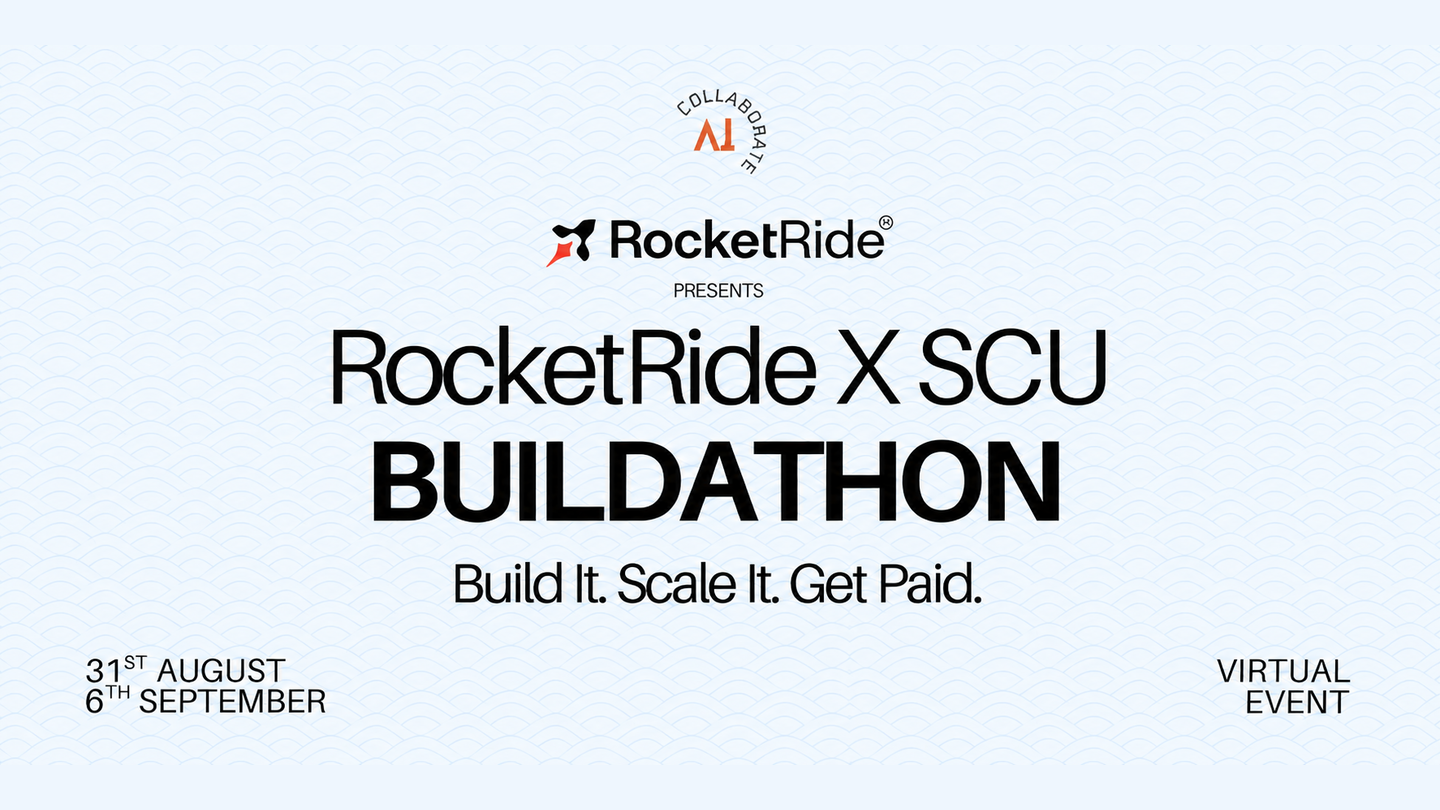
If you missed it, there is one you can join from anywhere, and it is running right now. RocketRide and AI Collaborate at Santa Clara University are hosting the SCU Buildathon online from August 31 to September 6. Build an AI pipeline or an automation, publish it on RocketRide, and get real users on it. Winners take 1,000 dollars in credits. It is open to every university, not only SCU, solo entries welcome and teams up to four. Submissions open on September 4 and the deadline is September 6.
The bar is not technical complexity. It is whether someone would choose your app over doing it themselves. Build. Connect. Share. Take off.
The week's AI news that changes how you build.
Nvidia released a 30B open model built for speed on any modern GPU.
Nemotron 3.5 Lightning landed on August 11 with OpenMDW-1.1 open weights and 3B active parameters in a 30B mixture of experts. NVIDIA's own benchmarks show 4x the output speed of similar sized models and 86 percent accuracy on PinchBench. The weights run on Blackwell, Hopper, and Ampere GPUs, quantized checkpoints included. If your pipeline is locked into closed models because the alternatives were too slow, this one runs the math differently.
A frontier multimodal model shipped with MIT weights and 1M context at a promotional price.
Z.ai released GLM-5.3-Flash on August 26: 320B total parameters, 18B active, natively multimodal text, image, and video, 1M token context. MIT licensed. The list price is 15 cents per million input tokens and 50 cents per million output, and a 50 percent promotional discount runs through September 9. If you cut a vision or video reasoning step from your pipeline because the economics didn't work, the economics just changed.
The hardware under your inference bill just got more expensive.
Nvidia has told server makers that systems built on its AI chips will cost more than 15 percent extra, and supply chain sources put the top of that range near 17 percent depending on how much memory a configuration carries. Grace Blackwell and Vera Rubin systems are both affected, and the increases land on machines shipping early next year. The contract manufacturers that build for Microsoft, Google and Oracle have already passed word to their customers. The cause is memory, not silicon: HBM demand is outrunning supply. Rented GPU hours are priced off that hardware, so the floor under every always-on pipeline you run is moving up with it.


Member discussion