
Mission #24: Publish your app on our Marketplace, the first month is on us


The first agent is easy: one developer, one account, full access. By the fifth agent and the third teammate, "everyone can do everything" stops being convenient and starts being a risk. Someone restarts the production agent to test a prompt, an experiment runs against live data, and nobody is sure who was allowed to do either.
On RocketRide Cloud access is organized the way your team already works. Organization admins invite people, set their roles and create teams. Everyone else gets exactly the access their teams give them: within each team, you decide who can start and stop agents and who can only watch them run. Anything someone is not allowed to do is refused with a clear error, never skipped silently.
Teams double as your environments, so Development and Production are two teams with two different lists of who can act. Putting a version live means pointing Production at it, and only people with control on Production can do that. Each of those moves lands in the same immutable deploy history we covered in Mission #17, which records who deployed what, and when.
Everyone can still build. Not everyone deploys to production.
How team permissions work
Access works at two levels. At the organization level, an admin manages members and their roles, creates teams, holds the organization's shared keys and sees usage broken down by team and by person. At the team level, each membership carries its own permissions, so the same person can control agents on Development and only monitor them on Production.
API keys follow the same lines. A personal key can be scoped to a single team with only the permissions you pick, and it can never do more than its owner is allowed to, so the key you hand a CI job reaches one team and nothing else.
Built something at a hackathon? Publish it on our Marketplace, and the first month is on us. Deploy your hackathon app on the RocketRide Marketplace and we cover your first month on the Builder plan, then feature it on RocketRide's LinkedIn, Instagram and Marketplace. Open to the first 5 apps: message us on the RocketRide Discord with a link to what you built.
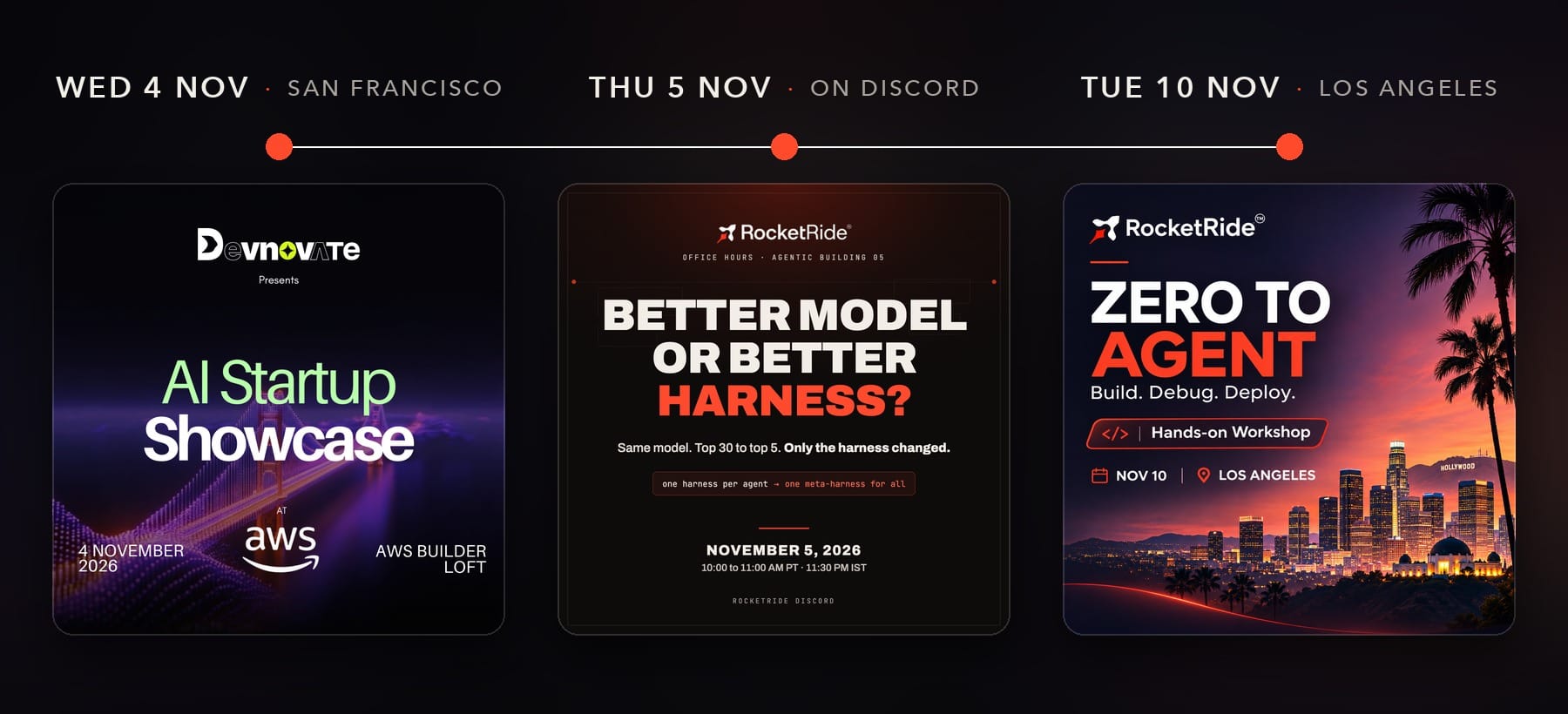
Three dates in the next seven days, all free: startups on stage in San Francisco this morning, an open conversation on Discord tomorrow, and a hands-on build in Los Angeles next Tuesday.
- AI Startup Showcase, today, Wednesday 4 November, 9:30 AM to 2:00 PM Pacific at the AWS Builder Loft in San Francisco's Financial District. Founder presentations from 10:15, live AI demos from 11:15, lunch, then a founder and investor panel at 1:00. The host approves each registration, the AWS portal signup is mandatory, and guests must be 18+ with a physical government photo ID. Register for the Showcase
- Office Hours: Better Model or Better Harness?, tomorrow, Thursday 5 November, 10:00 to 11:00 AM Pacific on Discord, with Mithilesh Gaurihar, Krish Garg, Josh Phillips and Mansi More. Part 5 of our fortnightly agentic building series: why the same model can score very differently depending on what surrounds it, and what changes when you run five harnesses instead of one. About ten minutes on the topic, then open discussion, voice or chat. Recorded, with a written summary after, and no need to have joined earlier sessions. Join on Discord
- Zero to Agent with Josh Phillips, Tuesday 10 November, 5:30 to 8:30 PM Pacific in Los Angeles. A hands-on codelab: build an AI app step by step in your IDE, test and debug it, then deploy it to RocketRide Cloud before you leave. The host approves each registration. Bring a laptop with VS Code, Cursor or Windsurf and do the 15-minute pre-workshop setup first, including your Cloud account and API key; workshop credits are handed out on the day. Register for Zero to Agent
Further out, HackwithBay 4.0, an eight-hour hackathon, is on Tuesday 24 November and AI Demo Night on Friday 4 December, both at the AWS Builder Loft.
The week's AI news that changes how you build.
Google's Gemini 4 Carbon ranks #1 on Artificial Analysis, and developers have to wait for it.
Last Wednesday Google DeepMind introduced Gemini 4 Carbon, which it calls its strongest model, with state-of-the-art cybersecurity and long-horizon capabilities. Google says it ranks first on version 5.0 of the Artificial Analysis Intelligence Index with a score of 59, and that prompt-injection attacks in Gray Swan's test succeeded 0.0% of the time, against 0.7% for Argon (their numbers). Access starts with a subset of cyber defenders, then trusted partners through Google's Fairwind Program; developers and businesses get it "as soon as possible", with no date given. The launch price is $2 per million input tokens and $10 per million output, rising to $4 and $20 after an introductory period. Budget for it now, but keep your pipeline on models you can call today.
ChatGPT Pro and Business plans now come with up to $500 a month in OpenAI API credits.
Since last Wednesday, OpenAI lets eligible ChatGPT subscribers claim API credits as part of their plan. Pro gets $100, $200 or $500 a month depending on tier, and Business gets $20 per paid Standard seat or $100 per paid Premium seat, pooled and capped at $500 per workspace. You link an API organization you own, under the same email, once the plan has been paid for at least seven days. Plus, Go, Free and Enterprise plans do not qualify, unused credits expire at the end of each billing cycle, and Codex used through API keys is not covered. If your team already pays for ChatGPT, that is prototyping budget for every OpenAI step in your pipeline.
A backdoored Claude Code extension sat on Cursor's marketplace for 11 hours.
Last Thursday, from about 2:27 AM to 1:35 PM Pacific, Cursor's extension marketplace served tampered builds of the Claude Code extension, versions 2.1.312 and 2.1.313 for Windows and macOS. The payload reported host details, tried to add an SSH key labelled svc-telemetry, tried to open a reverse SSH tunnel and set up scripts to keep it alive, and Cursor warns that uninstalling the extension may not be enough. Cursor says the tampered versions were not built by Anthropic, and it shut down, re-keyed and rebuilt its marketplace before bringing it back. If anyone on your team used Cursor that day, check for the svc-telemetry key, because a laptop holding model keys and pipeline credentials is part of your AI stack.


Member discussion