
Mission #25: Your first Builder month comes with 2x tokens


The first version of an agent is one prompt. Then it also has to research, then write, then check its own work, then format the answer, and every new job adds another paragraph of instructions competing with the rest. By the fourth job it is doing none of them well.
On RocketRide Cloud the fix is the one teams already use: split the work. Any agent node can be called as a tool by another agent, so a lead agent hands a question to a research agent and gets the answer back to combine with the others. Each specialist gets short, focused instructions and only the tools you connect to it.
You also choose the framework per agent. CrewAI, LangChain, LlamaIndex and Deep Agents all run as nodes on the same canvas, next to RocketRide Wave, our own agent, which plans each step as a set of parallel tool calls. The whole team lives in one pipeline, so it deploys as one version and rolls back as one, the way Mission #17 described.
One prompt can only get so good. A team gets better one member at a time.
How agents call agents
Connect an agent under a lead agent and the lead sees it as one more tool: a question goes in, an answer comes back. It works the same whichever framework each agent is built with. Two frameworks also bring their own crews: a CrewAI Manager hands work to its CrewAI Subagents and combines what they return, and a Deep Agent can delegate to subagents of its own.
A chain of steps can become one tool too. The Pipeline Tool node wraps part of the canvas, search then summarize for example, so an agent calls the whole chain like any other tool, and that chain can contain an agent with tools of its own. Start a run with full tracing and every hand-off shows up in the trace: which agent was called, with what, and what it sent back.
Start on Builder and your first month's tokens are doubled. Subscribe to the Builder plan on RocketRide Cloud and your first month comes with 5,000 tokens instead of the usual 2,500. Message us on the RocketRide Discord after you subscribe to claim the extra 2,500.
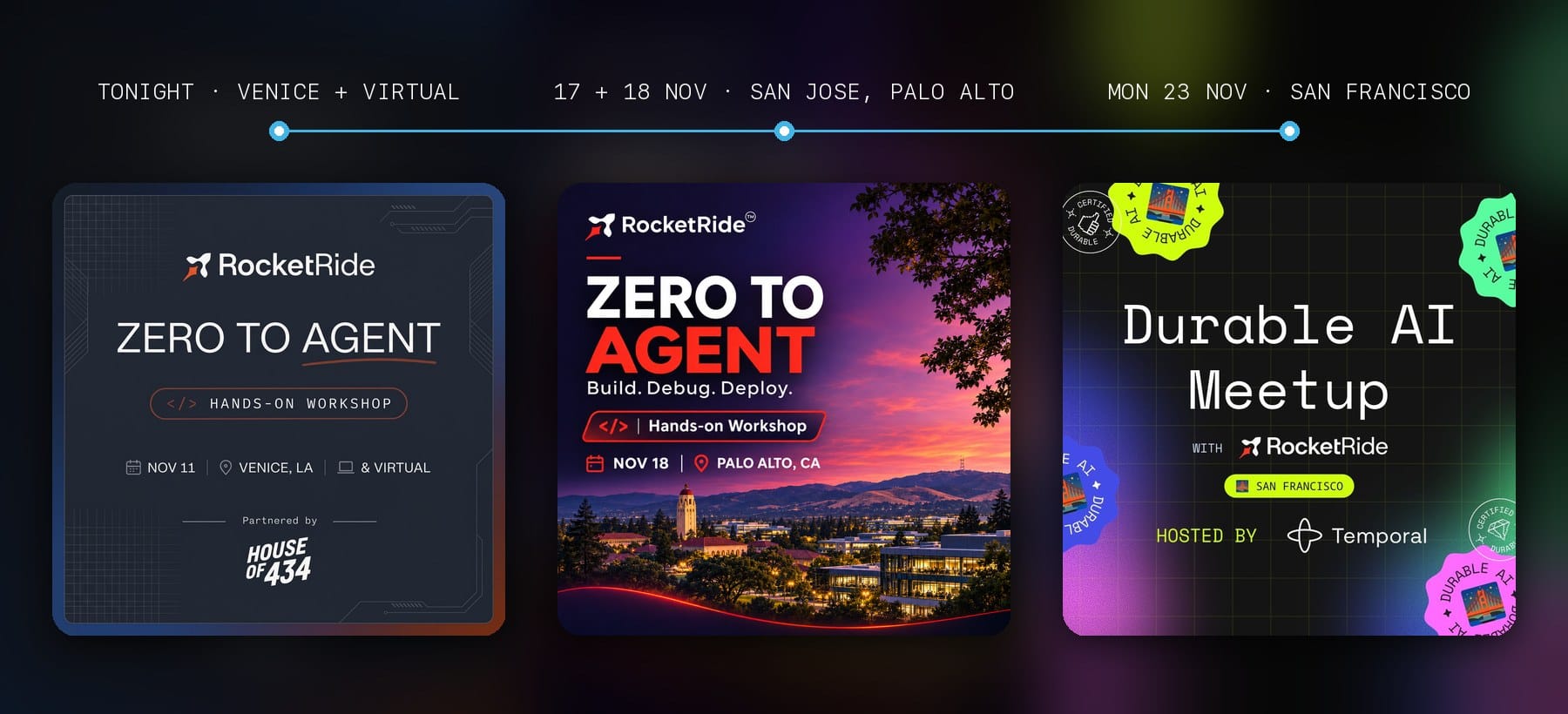
Four evenings to build with us in the next two weeks: tonight in Venice or online, two Bay Area workshops next week, and a meetup on production agents in San Francisco.
- Zero to Agent in Venice, tonight, Wednesday 11 November, 6:30 to 9:30 PM Pacific at 150 Horizon Ave, hosted by our venue partner House of 434, with Josh Phillips and the RocketRide team. Build an agent in VS Code with RocketRide, let your coding assistant build the app on top with a live preview, then deploy it to RocketRide Cloud. Host approval required; bring a laptop with VS Code, Cursor or Windsurf, finish the 15-minute pre-workshop setup first, and collect workshop credits on the day. If you can't be in Venice, the whole session streams live on the RocketRide Discord stage, so you can build along from anywhere and ask the team questions as you go. Register for tonight
- Zero to Agent in San Jose and Palo Alto, San Jose on Tuesday 17 November, 5:30 to 8:00 PM Pacific, and Palo Alto on Wednesday 18 November, 5:30 to 8:30 PM Pacific. The same guided codelab, from an idea to an app running on RocketRide Cloud; no RocketRide experience needed, basic coding helps. Free with no approval step, and the same setup as tonight: Python 3.10+, Node.js 20+, pnpm 10+, a Cloud account with an active subscription, and an API key. Register for San Jose · Register for Palo Alto
- Durable AI Meetup (November Edition), Monday 23 November, 5:30 to 8:00 PM Pacific near Union Square, San Francisco, hosted by Temporal. Lightning talks and demos on the layers around production agents, including a Temporal agent harness demo and a RocketRide talk, then food, drinks and networking. Made for engineers whose agent works in a demo and now has to survive real traffic and failures. Host approval required. Request a spot
Further out, AI Demo Night is on Friday 4 December, 5:00 to 8:30 PM Pacific at the AWS Builder Loft in San Francisco.
The week's AI news that changes how you build.
Claude Fable 5.2 tops Artificial Analysis at 65, and it is strict about your conversation history.
On Monday Anthropic released Claude Fable 5.2, alongside Mythos 5.2, the same model with fewer safeguards, offered only to vetted cybersecurity and biomedical research teams. Anthropic reports outputs up to 30% faster than 5.1, and Artificial Analysis now puts Fable 5.2 first on its Intelligence Index at 65, ahead of Gemini 4 Carbon at 60. It costs $8 per million input tokens and $40 per million output as claude-fable-5-2, or $16 and $80 in a fast mode that generates up to 2.5 times quicker. One catch for pipelines: if the system prompt, the tools or any message before a thinking block changes on a later request, Fable 5.2 returns a 400 error on every account by default, so pass each response back unchanged instead of trimming or rewriting history.
Gemini 4 Carbon opened to developers yesterday, and two older Gemini models change on 1 December.
Last week we wrote that developers would have to wait for Gemini 4 Carbon; on Tuesday Google made gemini-4-carbon generally available in the Gemini API. The introductory price of $2 per million input tokens and $10 per million output runs until 30 November, then doubles to $4 and $20 on 1 December, with no free tier. The same date matters even if you never touch Carbon: requests to gemini-2.5-pro start routing to Gemini 3.8 Flash and gemini-2.5-flash to Gemini 3.5 Flash-Lite, billed at those models' rates. Google lists breaking changes in both moves, including function-calling and thought-signature validation, and thinking_level replacing thinking_budget, so test any pipeline step still pinned to 2.5 before then.
Meta's Muse Ember is built for the small, repeated steps inside an agent.
On Monday Meta released Muse Ember, its smallest and most efficient model, aimed at the repeatable work inside agents: tool calls, routing, extraction, coding subtasks and long-document parsing. It takes text, images, audio and video, has a 1M-token context window, and costs $0.10 per million input tokens and $0.50 per million output for prompts up to 200K tokens, as muse-ember-1.0 on the Meta Model API. Meta puts it ahead of GPT-6 Luna and Claude Haiku 5.5 on most of its agent benchmarks, while it trails Haiku 5.5 on FrontierCode 2.0 (their numbers). The pattern worth copying is the split: a frontier model plans, and a cheap model makes the hundred small calls that add up on the bill.


Member discussion