
Mission #21: Upgrade this week, get our engineer for 30 minutes


Where does your project live? Half in a repo, half in a dashboard somebody set up in March, and the part that actually matters in a browser tab nobody can reproduce. A new teammate opens a laptop and the first day goes to archaeology.
On RocketRide Cloud, the workspace is a folder. Three directories you own, ./apps for app projects, ./pipelines for standalone .pipe files, ./nodes reserved for future custom components, and one directory the platform maintains, .rocketride, holding the docs, the component catalog, every config schema, and the packages your apps build against. Git carries the whole thing, because there is nothing else to carry.
Getting there is one command. rocketride init signs you in, syncs the catalog and schemas, vendors the platform packages, installs the docs, and gitignores what should never be committed. Run it again any time and it refreshes everything against the connected server. A teammate clones the repo, runs init, and has your exact workspace.
A project you can clone is a project you can hand over. Keep it in a folder.
What one command sets up
Run rocketride init in an empty folder and you get a working project: it signs you in, pulls down the component catalog and the config schema for every node, installs the docs, and vendors the packages your apps build against. All of that lands in one hidden .rocketride directory. Your own work, the apps and the pipelines, sits next to it in plain folders you commit like any other code.
The one rule: leave .rocketride alone. The platform refreshes it every time you run init again, so anything you edit there is overwritten. Keep your changes in your own folders and the refresh never touches them. The payoff is that a teammate clones the repo, runs one command, and is looking at exactly what you see.
Stuck between local and production? We will get you deployed. Upgrade your plan this week and the first 20 get a 30-minute laptop-to-production session with a RocketRide engineer, on us. Upgrade, then reply to the Mission #21 email and we book it.
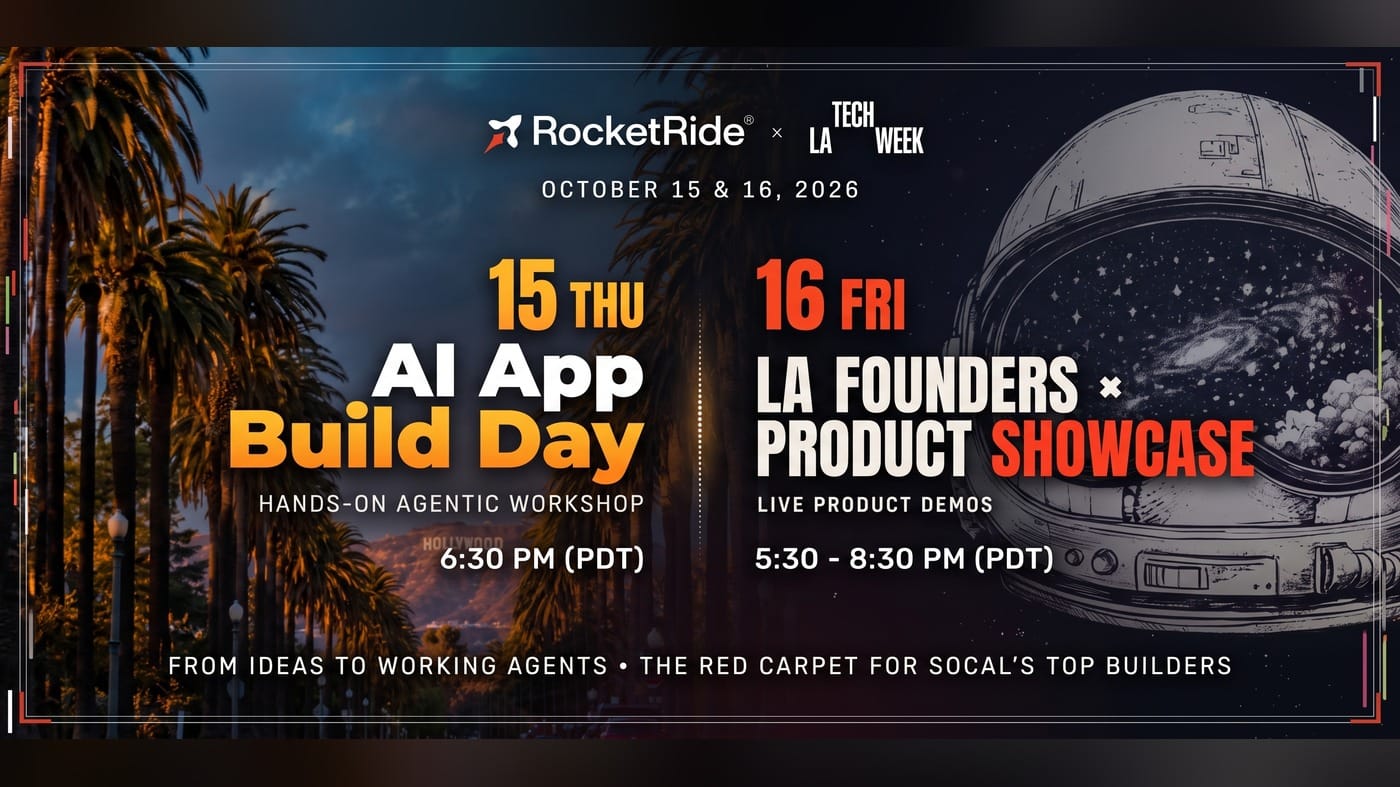
#LATechWeek is this week, and we are bringing two nights you can still get into.
- AI App Build Day, Thursday 15 October, 6:30 to 9:00 PM Pacific in Santa Monica. The hands-on agentic workshop Josh Phillips ran in San Francisco, now for LA: in 90 minutes on RocketRide you build the claims desk for Specter Mutual, a ghost insurer with genuinely unhinged claims. A claim arrives through a webhook, your agent reads it, decides approve, deny or escalate, and writes the letter, while a small piece of plain code checks that decision against the policy. Then the room turns fraudster and tries to break it. Bring a laptop. Limited spots, RSVP on Partiful.
- Founders Product Showcase, Friday 16 October, 6:00 to 9:00 PM Pacific in Los Angeles. A private demo night hosted by RocketRide: doors and drinks at 6, two rounds of founder demos from 6:30, open networking from 8. Founders get a few minutes on stage with a live product and the hardest part of getting it into production, no slides, no sales pitches. RSVP on Partiful. Want to demo? Slots are limited, apply for a demo slot.
One more thing from last week, and it matters. The Zero Human Startup Hackathon winner is Samuel Saras with CoopOS, the AI back office for student housing co-ops. A team of AI agents checks proposals against the house bylaws, drafts motions, agendas and notice emails, and builds weekly workshift plans from members' availability. The AI drafts and checks; volunteers decide. That line is the whole argument for agents in production, and a student co-op got there in a day.
Back in San Francisco after LA: the Universal Hackathon on Monday 19 October and the SF AI Summit on Wednesday 21 October, both at AWS Builder Loft. The calendar has everything else.
The week's AI news that changes how you build.
Claude Haiku 5.5 launched on 7 October at $0.10 per million input tokens and $0.50 per million output, for prompts under 100,000 tokens; above that the rate is $0.50 and $2.50. Anthropic says about 90 percent of Haiku 4.5 requests stayed under that line, and that typical workloads cost roughly 75 percent less than on Haiku 4.5 once token consumption is accounted for. It is pitched at the repetitive work that makes agents expensive at scale: summarizing documents, classifying, querying databases, and taking the small jobs handed down by a more capable agent. If a node in your pipeline does that kind of work, this is the week to check what it is running on.
EmbeddingGemma 2 shipped on 6 October under Apache 2.0. It maps text, code, images, video and audio into a single 768-dimension space, truncatable to 512, 256 or 128, with an 8K context that covers about 5.5 minutes of audio or 29 images per input. Text-only runs on 270 million parameters, the full multimodal model on 740 million, small enough for on-device search at around 567 MB of RAM quantized. It is on Hugging Face and Kaggle with day-one support in Ollama, llama.cpp, MLX and vLLM. For a RAG pipeline that has been keeping separate indexes per media type, this is one index.
Meta and Sierra want a standard for the moment an AI agent shows up at a company's front door.
On 7 October Meta and Sierra proposed the Personal Agent Protocol, an open standard for how consumer AI agents interact with businesses: a company can tell when an agent is acting for a customer, verify that relationship, and decide what the agent is allowed to do. Genesys, Instinct, Rocket, Shopify, Stripe and Walmart are participating, and a version 0.1 specification with a reference implementation is promised later this month. If your pipeline sits on the company side of that door, the interesting question is what it will accept from an agent that is not yours.


Member discussion