
Mission #13: You version your code. Why not your AI?


You'd never accept this for regular software. Your code has branches, staging, tagged releases, a diff behind every change, because that discipline is what lets you ship to real users without holding your breath. Then the AI parts arrived: prompts drifting a word at a time, pipelines edited live in production, and three weeks later nobody can say what changed before the numbers dipped.
RocketRide Cloud is putting the discipline back, and our Chief Architect Rod Christensen just demoed it end to end. Every pipeline moves through design, development, staging, and production, with fully versioned history the whole way, so "what's deployed" has an answer instead of a guess. And when the numbers disagree with everyone's optimism? Rod rolled a live pipeline back from version 2 to version 1, on screen, in one click.
Not glamorous. But this is the part that was always missing from AI-Ops: the Ops. It's coming to your workspace soon.
The workspace now separates design, development, and deploy, so a pipeline's journey has named stages instead of one shared canvas everyone edits live.
In the demo, a pipeline sat deployed as version one in a staging group. Scheduling is built in: cron-style syntax defines when a pipeline runs, hourly, daily, weekly, and stop conditions handle both kinds of pipelines, the ones that finish on their own and the ones, like chat, that never end and get a fixed window instead. Version two went to staging for testing while version one kept serving production. When version two was promoted and something looked wrong, production rolled back to version one, live on screen.
That's the whole loop: versioned, staged, scheduled, reversible. For teams that ship AI the way they ship software, this is the missing half of the workflow.
Watch the deploy Demo, unedited.
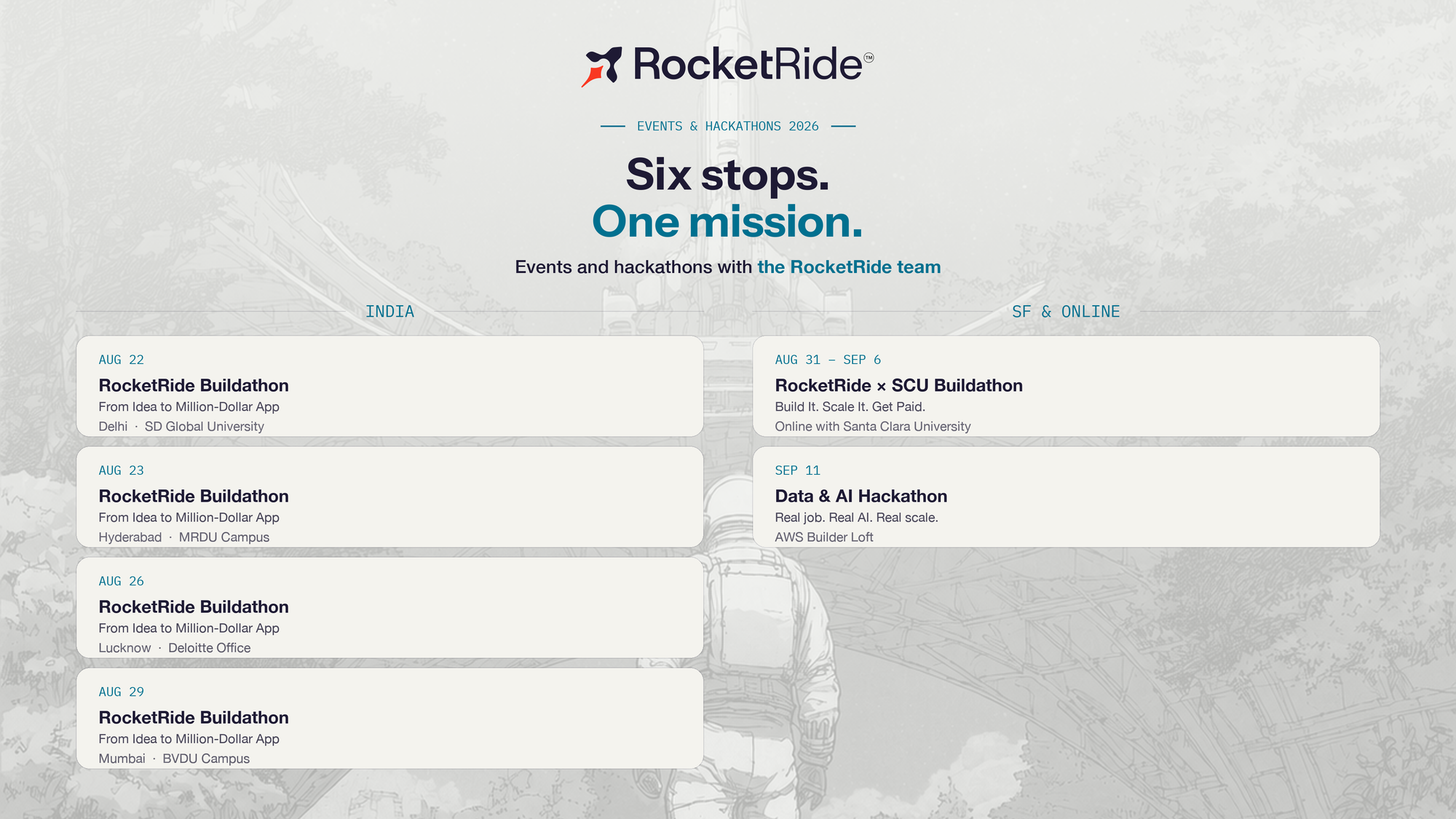
Starting this Saturday, the RocketRide team hits Delhi, Hyderabad, Lucknow, and Mumbai for the Buildathon series, From Idea to Million-Dollar App, then turns to SF for a week-long online buildathon with Santa Clara University and a Data & AI Hackathon at the AWS Builder Loft on September 11. Every stop comes with the RocketRide team on site or online, ready to help you get a pipeline running. Wherever you are, there's a stop for you.
The week's AI news that changes how you build.
The neutral AI router just got bought.
Stripe finalized its acquisition of OpenRouter last weekend, reportedly north of $7 billion, five times the valuation from three months ago. OpenRouter routes 400+ models for 8 million developers, and a lot of pipelines picked it precisely because it belonged to no one. Nothing changes today; the service keeps running. But the layer between your code and your models now has an owner with its own roadmap, and that is worth knowing before you renew a dependency.
Every word Claude writes now carries an invisible signature, and you can't turn it off.
Since August 11, all Claude text output embeds a statistical watermark, a compliance move under the EU AI Act, applied worldwide. Detection requires Anthropic's key, so third parties can't read it, and there is no opt-out on any plan. If your pipeline ships Claude-generated text to customers, that text is now traceable to its origin. Worth deciding whether that matters for your product before someone else decides for you.
Google open-sourced a compiler that runs models on encrypted data.
HEIR converts pre-trained models to run under homomorphic encryption: inference happens without the server ever seeing the input, or the result. It is still slow for large models, and Google says so. But the direction is clear: privacy is moving from a policy layer to an architecture layer. If you build pipelines for regulated data, this is the primitive to start reading about now.


Member discussion